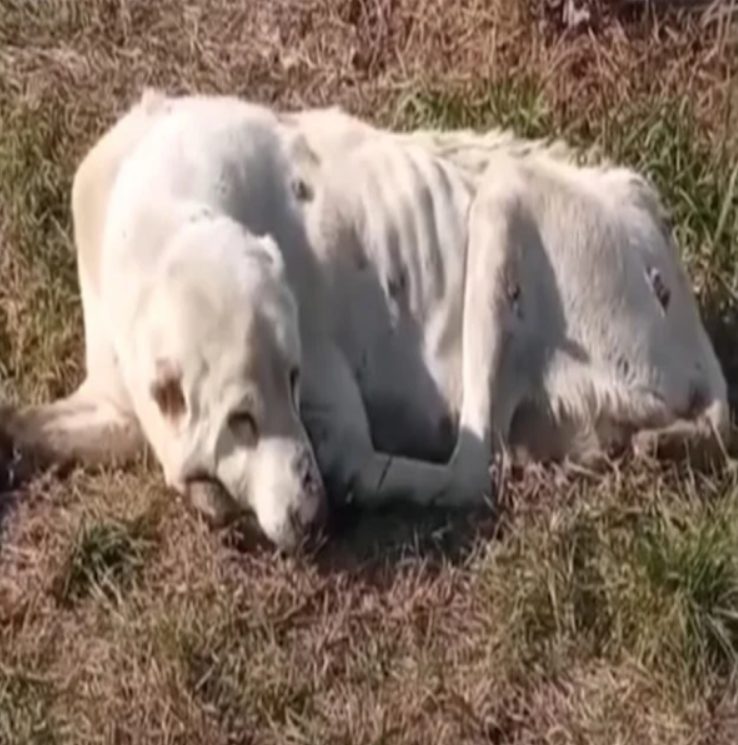
Snow’s story is one of those quiet, devastating rescues that begins in near silence—where suffering has gone on so long that even hope seems to have been worn away.

Years of neglect had reduced her to a frail shadow of the dog she once might have been. At an estimated 8 to 10 years old, Snow was no longer in the prime of life; instead, she had reached a stage where her body reflected everything it had endured. Hunger had stripped her down until her ribs pressed sharply against thin skin. Her muscles had wasted away from long periods without proper nutrition or care. Even her eyes—once likely full of expression and energy—now appeared dull, clouded with exhaustion and resignation.
It was not just physical decline. It was the kind of suffering that builds slowly over time, until an animal no longer reacts the way a healthy creature would. Snow had reached that point where survival itself had become passive. She no longer had the strength to search, to flee, or even to hope. She simply existed, lying still as the world moved around her without acknowledgment.
No one could say exactly how long she had been in that condition. Neglect does not always have a clear beginning or end. It accumulates quietly, in missed meals, in ignored suffering, in moments when help could have come but did not. By the time Snow was found, she had already endured far more than any animal should have to carry alone.
When the rescue team finally arrived, they were met not with resistance, but with stillness. Snow did not flinch at their approach. She did not growl or attempt to move away. There was no energy left for fear or defense. That absence of reaction often tells rescuers something deeply concerning—that an animal has passed beyond panic into exhaustion and surrender.

Even when they gently placed a muzzle on her for safety, she did not resist. It was done carefully, as it always is in situations where an animal’s condition is unknown, but Snow offered no opposition. It was as if she no longer had the strength to question what was happening around her.
The rescuers worked slowly, aware that any sudden movement could stress her already fragile body. With great care, they lifted her and carried her to their vehicle. The urgency of the situation was clear—Snow needed medical attention immediately, and every minute mattered.
She was transported to a veterinary clinic experienced in handling critical rescue cases, where animals often arrive in conditions that require immediate stabilization. The medical team there understood what they were facing: a body weakened by prolonged neglect, dehydration, and likely multiple untreated health issues.
Upon arrival, Snow was placed on fluids and given injections aimed at stabilizing her condition. Her body needed support simply to begin functioning again. A full examination followed, including diagnostic imaging such as an ultrasound, to check for hidden complications—internal injuries, organ damage, or underlying disease that could have developed over years of neglect.
The veterinarians worked quickly but carefully. Cases like Snow’s are always a delicate balance between urgency and caution. Pushing too fast can overwhelm a body already at its limit, but waiting too long can mean missing a narrow window of survival. Every decision was made with the understanding that her condition was critical, but not necessarily hopeless.
Through it all, Snow remained still. Not because she was unresponsive, but because she was depleted. Her body had nothing left to fight with, yet she was now in an environment where fighting was no longer required. For the first time in a long time, she was not alone.
The rescue team gave her a name: Snow. It was a soft, simple name, chosen with intention. Names in rescue work often carry meaning—they are a way of acknowledging that an animal is no longer just a case or a condition, but an individual with a future that has not yet been written. In Snow’s case, the name also symbolized purity, calm, and the possibility of renewal after hardship.

It marked a turning point, however small. She was no longer a forgotten presence on the edge of survival. She was a patient, a life under care, someone being given attention and time.
As she rested in the clinic, surrounded by people monitoring her condition, something subtle but important shifted. Even in her weakened state, she was no longer facing the world alone. Hands that moved gently around her were not causing harm—they were working to help her heal. Voices around her were not indifferent—they were concerned, focused, and steady.
Snow’s journey at that moment was still uncertain. There were no guarantees, no immediate signs that she would recover fully. Animals in her condition often require days of stabilization before any real improvement can be seen. The early phase is simply about survival—keeping the body functioning long enough for healing to begin.
Yet even in uncertainty, there was a shift in her story. She had moved from abandonment to care, from invisibility to attention, from being left behind to being fought for.
What comes next for Snow depends on time, medical support, and her own resilience. Recovery from severe neglect is never linear. There are small improvements, setbacks, and long periods of waiting. But what matters most is that she is no longer going through it alone.

Her body may be weak, but she is now in a place where weakness is met with support instead of abandonment.
Snow’s story, like many rescue cases, is not defined only by where she began, but by what is now possible. It is a reminder that even when an animal appears beyond help, intervention can still change the direction of their life. Compassion does not erase the past, but it can still reshape the future.

And for Snow, that future—however uncertain—now exists.
From Crisis to Comfort: Stray Puppy Duncan Finds Love, Healing, and a Forever Home
Duncan’s story begins in a fragile, painful state—one that is difficult to imagine without feeling immediate concern. As a tiny stray puppy brought to the Friends of Marshall Animal Shelter (FMAS) in Marshall, Texas, he arrived not with the playful energy usually associated with young dogs, but with visible suffering that marked every inch of his small body. His skin, instead of being soft and healthy, was covered in severe mange, leaving him with raw, irritated patches, painful sores, and thick scabs that made even simple movement uncomfortable.

For the volunteers at FMAS, it was immediately clear that Duncan could not wait for delayed intervention. His condition required urgent attention—not only to relieve his physical pain, but also to give him a real chance at recovery before his situation worsened. Mange, especially in severe cases, can be both physically exhausting and emotionally distressing for animals, stripping away comfort and leaving them vulnerable to infection, stress, and further decline.
Recognizing the urgency, the shelter team acted quickly and compassionately. They arranged for a foster placement with a family experienced in caring for medically fragile animals. This decision was crucial. While shelters provide safety and structure, foster homes often offer the individualized attention and calm environment needed for recovery, especially for animals requiring daily treatment.
Duncan’s new foster family welcomed him with patience and care, immediately beginning a structured treatment plan designed to heal his skin and ease his discomfort. A central part of this routine involved daily therapeutic baths. These baths were not simple cleaning sessions—they were carefully administered treatments intended to soothe inflammation, remove debris, and support the healing of his damaged skin.
But what made Duncan’s recovery truly remarkable was not only the medical care he received, but the emotional environment in which it was delivered.
Each bath became more than a treatment—it became a moment of reassurance. As Duncan was gently cleaned and treated, his foster family spoke to him softly, offering comfort and encouragement. For a puppy who had likely experienced neglect and discomfort for much of his early life, this consistent kindness was just as important as any medication. He was not simply being treated; he was being cared for.

Over time, these daily routines began to reshape not only his body, but his sense of safety. Trust, especially in animals who have suffered, develops gradually. At first, Duncan may have been uncertain, even anxious during treatment. But repetition, gentleness, and care created a predictable rhythm that helped him understand he was no longer in danger.
Just one week into this dedicated care, the transformation began to show in visible and meaningful ways. His skin, once inflamed and painful, started to heal. The sores became less severe, the scabs began to recede, and the irritation that had defined his early condition started to fade. Beneath the damage, his natural coat began to emerge, revealing patterns and markings that had been hidden under the effects of the disease.

For the people caring for him, this progress was deeply rewarding. It served as a reminder that even severe conditions can improve rapidly when addressed with consistent medical treatment and compassion. FMAS later reflected on this transformation with a simple but powerful message: “A little medicine and a loving foster go a long way.” That statement captures an important truth about animal rehabilitation—healing is rarely just physical. It is a combination of treatment, environment, and emotional care.
As the days passed, Duncan continued to improve. His energy increased, his comfort level rose, and his personality began to shine through the discomfort that had once overshadowed him. What had started as a fragile, suffering puppy gradually became a more confident and lively young dog. His recovery was not only visible on his skin, but also in the way he carried himself.
Eventually, his condition improved to the point where he was ready for the next stage of his journey: adoption. The shelter staff, who had watched him transform day by day, felt both pride and emotional attachment. Duncan had become more than just another rescue case—he had become a symbol of what dedicated care can achieve. They even described him affectionately as a charming mix, possibly with Dalmatian traits, noting his striking black spots emerging against his soft white coat.

Finding a permanent home took time, as it often does for rescue animals. Adoption is not only about recovery, but about finding the right match—someone prepared to continue the care and love that began in foster. But Duncan’s patience was eventually rewarded.
In November, he was adopted into a loving family who welcomed him as a full member of their home. The transition marked the completion of a long journey—from suffering stray puppy to healthy, joyful companion. In his new environment, Duncan was able to experience stability, affection, and the everyday comforts that had once been missing from his life.

Today, Duncan is no longer defined by the condition he arrived in. His mange is gone, his coat has recovered, and his personality has flourished. He enjoys life as a happy, vibrant dog, free from the pain that once dominated his early days. His transformation is a testament to what can happen when intervention is timely and care is consistent.

For the Friends of Marshall Animal Shelter, there is always a bittersweet element to stories like Duncan’s. While they miss the animals they nurture through recovery, they also understand that the ultimate goal is successful adoption and long-term happiness. Seeing Duncan thrive in his forever home is the reward that makes every difficult rescue worthwhile.

His journey serves as a quiet but powerful reminder that even the most visibly distressed animals can recover with the right combination of medical treatment, patience, and compassion. Duncan’s early suffering did not define his future. Instead, it became the starting point of a story that ended in healing, trust, and belonging.