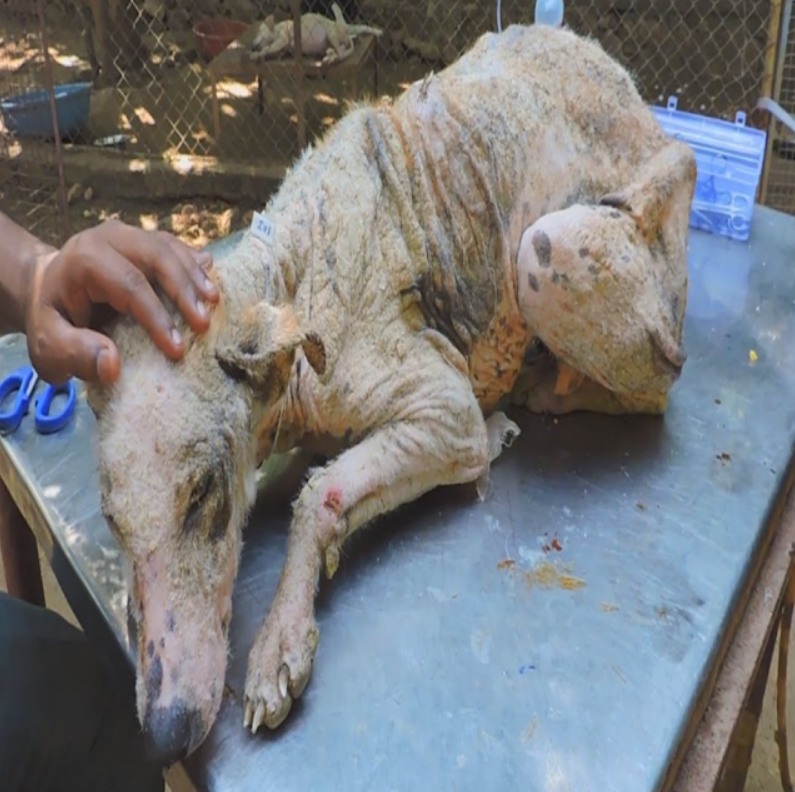
Beneath the weathered boards of an old porch, in the narrow space where shadows gathered and the earth smelled of damp wood and neglect, we found him. At first, he was little more than a trembling outline in the darkness, a pair of tired eyes reflecting the thin beam of our flashlight. When we knelt down and looked closer, the reality of his condition struck us with heartbreaking force. His body was frail, his ribs pronounced against taut skin that should never have been visible. Every inch of him told a story of suffering. He did not growl or bark. He did not attempt to run. He simply lay there, too exhausted to resist, too weak to hope.

His skin was ravaged by severe mange. What little fur he had left clung in uneven patches, revealing raw, inflamed flesh beneath. The irritation had clearly tormented him for weeks, perhaps longer. Mange had eaten away at his comfort and dignity, leaving him in constant pain. Angry red sores dotted his body, some crusted over, others still open and glistening. The infection had advanced to a horrifying stage—worms had found their way into his wounds, burrowing into vulnerable flesh and worsening his agony. It was a sight that no living creature should endure.
The porch above him had likely been his only shelter, a fragile barrier between his suffering and the elements. There was no food nearby, no water bowl tucked into a corner, no blanket or sign that anyone had cared for him in recent memory. His body spoke of prolonged hunger. His hips jutted sharply, and his limbs seemed barely strong enough to support him. When we offered a small bit of food, he sniffed weakly but could not bring himself to eat. His body had begun to shut down, conserving what little energy it had left. It was painfully clear that without intervention, he would not survive much longer.
Yet even in that fragile state, there was something in his eyes—a faint glimmer of awareness, perhaps even a quiet plea. It was not dramatic or desperate. It was simply there, like the last flicker of a candle fighting against the wind. That tiny spark was enough. We knew we could not leave him behind.
Our rescue team moved carefully, mindful that even gentle touch might cause him pain. One of us spoke softly, offering reassurance in a calm, steady voice. Another slid a blanket beneath his trembling body. He flinched slightly but did not resist. It was as if he understood that this moment was different, that these hands meant no harm. With slow precision, we lifted him and placed him into a carrier padded with clean towels. Every movement mattered. Every second felt critical.
The drive to the veterinary hospital was quiet, heavy with concern. We monitored his breathing, noting how shallow it was. His eyes closed for long stretches, and more than once we feared he might slip away before we arrived. But he held on. When the hospital doors opened and the medical team rushed forward to meet us, a sense of urgency filled the air.
He was immediately placed on a treatment table where skilled hands began assessing his condition. Intravenous fluids were administered without delay, delivering hydration and essential nutrients directly into his bloodstream. His body, starved and dehydrated, desperately needed stabilization before anything else could be addressed. Warm blankets surrounded him, and heating pads were placed nearby to help regulate his temperature.

The veterinary staff worked with meticulous care to treat the mange that had consumed his skin. Medicinal baths were prepared to soothe inflammation and eliminate the mites responsible for his torment. Each sore was cleaned thoroughly. The wounds harboring parasites required delicate attention; the removal process was painstaking, but it was necessary to prevent further infection. Antibiotics were introduced to combat bacterial invasion, and pain management ensured he would not endure additional suffering during the healing process.
Though his body was battered and weak, that glimmer in his eyes remained. Even as he lay connected to IV lines, even as medical interventions surrounded him, he did not surrender. When someone spoke gently to him, his ears twitched. When a hand rested lightly on his head, his breathing seemed to steady. That quiet determination became our motivation. If he was willing to fight, then so were we.
The first few days were precarious. His appetite was nonexistent at first, and nourishment had to be carefully introduced in small, manageable amounts. Too much too soon could overwhelm his fragile system. But gradually, almost imperceptibly, progress began. He started licking at soft food offered from a spoon. His eyes opened more frequently. His breathing grew stronger, more rhythmic.
As days turned into weeks, his transformation began to unfold in ways that felt almost miraculous. The inflammation in his skin slowly subsided. The angry redness faded to a softer pink, then to healthy tones. Fresh skin formed where sores had once been. The itching that had likely driven him to misery for so long began to ease. For the first time in what must have been months, he could rest without constant irritation gnawing at him.
His appetite returned with surprising enthusiasm. Meals that he once ignored were now greeted with cautious eagerness. With proper nutrition, his body responded gratefully. The sharp outlines of his ribs softened. Muscles strengthened. He gained weight steadily, each pound representing not just physical recovery but renewed vitality.

Perhaps one of the most heartwarming changes was the return of his fur. At first, it appeared as a faint fuzz along his back and legs, barely noticeable but undeniably present. Week by week, that fuzz thickened into soft, healthy fur. The once patchy, inflamed skin was gradually covered by a warm coat that restored both protection and dignity. Watching that transformation felt symbolic—as though he were being wrapped in comfort after a long season of exposure.
Yet his physical healing was only part of the journey. Emotional wounds often linger longer than physical ones. In the beginning, he would shrink back at sudden movements, his body remembering hardships that his mind could not easily forget. But patience became our greatest tool. Gentle voices, consistent routines, and kind hands slowly reshaped his understanding of the world.
One afternoon, as a caregiver approached his kennel, something remarkable happened. Instead of retreating to the far corner, he lifted his head. His tail, hesitant at first, gave a small wag. It was brief and uncertain, but it was there. That simple gesture felt monumental—a declaration that fear was loosening its grip.
Over time, those tentative tail wags grew stronger. He began greeting familiar faces with visible excitement. He leaned into gentle strokes, discovering comfort in human touch rather than threat. His posture changed, too. The hunched, guarded stance gave way to a more relaxed, confident bearing. He started exploring his surroundings with curiosity instead of caution.

The dog who once lay motionless beneath a porch now trotted across grassy spaces during supervised outings. He sniffed the air with interest, his ears perked at new sounds. Sunlight glinted off his restored coat. Laughter often accompanied his playful bursts of energy as he chased toys for the first time. Each joyful moment felt like a triumph over the suffering he had endured.
His transformation became a powerful testament to resilience. Animals possess a remarkable capacity to endure, to adapt, and to trust again even after profound neglect. What he needed was not extraordinary intervention but compassion, consistency, and the chance to heal. Given those, he flourished.
Eventually, the day arrived when he was ready for the next chapter of his life. No longer fragile or fearful, he stood tall and alert, eyes bright with curiosity. The hospital staff who had once feared for his survival now marveled at his strength. The rescue team who had first lifted him from the shadows felt overwhelming pride and gratitude.
Today, he thrives in an environment defined not by neglect but by warmth and love. His days are filled with nourishing meals, comfortable rest, and affectionate companionship. The porch that once served as his last refuge has been replaced by a home where he is cherished. His tail wags freely, his bark carries confidence, and his eyes no longer hold quiet desperation but joyful trust.

His journey from suffering stray to beloved companion is more than a story of medical recovery. It is a reminder of the profound impact that compassion can have. It demonstrates that even when circumstances seem hopeless, timely intervention and unwavering dedication can rewrite the ending. Every life holds value. Every creature deserves dignity and care.
Beneath that porch, we found not just a dog in need, but a life worth fighting for. And because someone chose to act, that life now flourishes—no longer defined by pain, but by the promise of a second chance.
From Street Stray to Cherished Companion: Kenzo’s Remarkable Journey of Renewal and Trust
When Kenzo was first discovered, he was barely able to stand. His thin legs trembled beneath the weight of a body that had endured far too much for far too long. Every rib was visible beneath his matted fur, and open wounds marked his fragile frame like painful reminders of neglect. His once-soft coat had become tangled and dirty, clinging to him in rough patches. It was clear at a glance that Kenzo had been surviving, not living.

He had been roaming the streets in search of scraps—anything that might quiet the relentless ache of hunger. With no stable shelter, he likely sought refuge wherever he could: under parked cars, near alleyways, beside buildings that offered slight protection from wind and rain. His eyes, though clouded with exhaustion, still held something remarkable. There was hope in them. A quiet, persistent hope that someone might notice him. That someone might care.

Despite the suffering etched into his body, Kenzo’s determination to survive shone through. He continued moving, even when his strength faltered. He continued searching, even when rejection seemed constant. That determination became the spark that ignited the beginning of his recovery journey.
When compassionate individuals finally intervened, they wasted no time. Kenzo was promptly taken to a veterinary clinic, where the gravity of his condition became fully apparent. He was severely undernourished, dehydrated, and weak. His body temperature was low, and his wounds required immediate cleaning and treatment to prevent infection. The veterinary team moved swiftly, administering fluids to combat dehydration and antibiotics to address underlying infections.

As the fluids began restoring balance to his system, Kenzo drank water with an urgency that startled everyone. That first night, he consumed more water than expected, raising some concern among his caregivers. Yet it was also a sign—his body was responding. It was waking up from prolonged deprivation. For perhaps the first time in a very long while, Kenzo was receiving proper care. Clean bedding replaced cold pavement. Gentle hands replaced indifference.
The following day posed new challenges. Though physically safer, Kenzo remained emotionally guarded. The unfamiliar sounds of the clinic—the beeping monitors, footsteps in hallways, doors opening and closing—made him flinch. Even the softest approach caused him to recoil. When someone reached out to pet him, he instinctively shrank back, unsure of what to expect.
His fear was not aggression; it was survival. His past traumas had left deep scars, both visible and unseen. Trust had likely been broken before, and rebuilding it would take patience. Watching him tremble at minor movements was heartbreaking. Yet within that fear, caregivers noticed something encouraging: he did not lash out. He did not shut down completely. Beneath the anxiety, there was a subtle willingness—a quiet openness to try again.
That willingness became the foundation for healing.

Gradually, day by day, Kenzo began to improve. His wounds were cleaned and dressed regularly, and with the help of antibiotics, they started to close. The swelling subsided, and healthy tissue replaced damaged skin. Nutrient-rich meals were introduced carefully, ensuring his weakened digestive system could adjust. With each proper feeding, his strength increased incrementally.
Emotionally, progress came in small but meaningful milestones. One day, he allowed a caregiver’s hand to rest on his back for a few seconds longer than before. Another day, he accepted a treat without retreating to the corner. His trembling lessened. His eyes, once darting anxiously around the room, began to soften when familiar faces entered.
Each step forward brought him closer to healing. He started responding to gentle words, tilting his head as though trying to understand the kindness being offered. The first time his tail gave a hesitant wag, it felt like a victory. That small motion symbolized something profound: trust was beginning to take root.

As weeks passed, Kenzo’s transformation was nothing short of extraordinary. The emaciated dog who had struggled to stand now walked with increasing steadiness. His appetite became healthy and consistent. The dullness in his coat disappeared as proper nutrition worked its quiet magic. Slowly, tangled fur was trimmed away, and new, glossy strands grew in its place.
His eyes changed the most. Where there had once been desperation and guarded caution, there was now light—curiosity, engagement, even joy. He began exploring his surroundings rather than shrinking from them. He showed interest in toys, tentatively nudging them before breaking into brief, playful bursts.
He gained weight steadily, filling out into a strong, healthy frame. His posture shifted from hunched defensiveness to upright confidence. The dog who once flinched at every movement now approached caregivers willingly, seeking affection. He leaned into gentle strokes and closed his eyes in contentment.
From a fearful stray, Kenzo blossomed into a lively, affectionate companion. Gratitude seemed to radiate from him in subtle ways—in the way he followed his caregivers with loyal attention, in the soft sigh he gave when resting comfortably, in the eager wag of his tail at the promise of a walk.
Eventually, the day came when Kenzo was ready for a permanent home. A family learned about his journey and saw beyond his difficult past. They saw resilience. They saw a spirit that had endured hardship yet remained capable of love. They welcomed him with open arms.
Today, Kenzo lives with a family that cherishes him deeply. His days are structured around comfort and joy—morning walks, nourishing meals, soft beds, and affectionate companionship. The once-hungry stray now has a yard to explore and people who celebrate his every milestone. He will never again have to search for food in alleyways or sleep uncertain of his safety.
A picture of health and contentment, Kenzo’s former struggles have faded into distant memory. Though his past shaped him, it no longer defines him. What defines him now is the love that surrounds him.

Kenzo’s journey highlights the incredible power of compassion and patience. Healing did not happen overnight. It required consistent care, gentle reassurance, and a refusal to give up on a frightened soul. His caregivers understood that rebuilding trust is just as important as treating wounds.
From being a hungry, neglected stray, Kenzo now stands as a cherished pet—proof that even the most sidelined spirits can flourish when given the chance. His story reminds us that beneath fear and suffering often lies untapped potential for joy.
He embodies survival, hope, and the profound transformation that kindness can bring. Once barely able to stand, Kenzo now runs freely, his coat gleaming in the sunlight. Once uncertain and alone, he now rests peacefully beside those who love him.

Kenzo truly lives like a prince, enjoying the life he always deserved—a life defined not by hardship, but by warmth, security, and unwavering affection.
Fifty the Pit Bull Overcomes Adversity to Become a Symbol of Resilience and Hope
Fifty: A Story of Courage, Resilience, and Unconditional Love

Fifty, a lovable Pit Bull, was destined from birth to bring joy and companionship to those around him. His journey began under the care of a kind-hearted family who rescued his pregnant mother, ensuring she and her future litter would have a safe and loving environment. Among his siblings, Fifty quickly distinguished himself—not through dominance or mischief, but through his gentle nature and playful spirit—and was chosen to become a cherished part of the family.

Life for Fifty initially unfolded like any happy puppy’s story. He enjoyed playful days in the company of his human family and shared a special bond with his canine companion, Izzy. The warmth of his home, the attention of his family, and the companionship of Izzy provided him with a sense of belonging and security. He was a dog in whom joy and love were evident in every wag of his tail, every excited bark, and every playful leap. It seemed as if nothing could disrupt the harmony of his young life.
However, life can be unexpectedly cruel, and Fifty’s story took a tragic turn. During an unfortunate encounter, a patrolling police officer, acting out of mistaken concern, shot Fifty in both of his right legs. This traumatic incident abruptly changed his life, forcing the amputation of these limbs and thrusting him into a world of unforeseen challenges. In an instant, Fifty transitioned from a carefree puppy to a dog confronting the realities of physical disability, pain, and the need to adapt to a completely new way of life.

The aftermath of the shooting was not just physical but emotional. Fifty had to learn to navigate the world with a body that had been irrevocably altered, and the family he had relied on now faced additional burdens. Economic difficulties eventually compelled his family to surrender both Fifty and Izzy to a local shelter. This sudden loss of home and familiar faces could have broken any dog’s spirit, yet Fifty’s resilience began to shine through during this challenging period.
At the shelter, Fifty demonstrated extraordinary determination. Despite losing two limbs, he refused to allow his disability to define him. He learned to balance, walk, and even run using his remaining legs, embodying a spirit of perseverance that inspired everyone who witnessed his progress. His ability to adapt and continue to embrace life with energy and enthusiasm became a source of hope, not just for himself, but for the shelter staff and volunteers who came to care for him.

Nine months later, Fifty’s persistence and courage were rewarded. He found his forever home with a family who welcomed him wholeheartedly. In this new environment, he quickly formed deep bonds with his human siblings and other animals in the household. The joy of belonging once again enveloped Fifty, allowing him to thrive in a safe and nurturing space. Playtimes, walks, and snuggles became daily reminders of what life could be when love and support are constant companions.
Fifty’s new family also regularly fosters dogs in need, creating an environment in which he could extend his own experiences into empathy and support for others. His resilience, understanding, and gentle nature make him a perfect companion and mentor for foster dogs, particularly those recovering from trauma or physical challenges. Fifty’s journey thus becomes a ripple of positivity, showing that one dog’s survival and adaptability can inspire and guide others.

Beyond his personal triumphs, Fifty’s story carries a broader message about the potential and perception of Pit Bulls. Often misunderstood and stereotyped as aggressive, Fifty demonstrates that this breed, like any other, possesses qualities of loyalty, courage, and gentleness. He defies misconceptions not through words but through actions—through his ability to forgive, adapt, and thrive despite life-altering circumstances. Fifty is a living testament to the fact that breed does not dictate character, and that love, care, and opportunity can shape even the most resilient of hearts into beacons of hope and companionship.
Fifty’s journey from trauma to triumph is not simply a tale about a dog overcoming adversity; it is a story about the power of resilience, the importance of human compassion, and the profound capacity for animals to inspire those around them. He endured physical injury, the loss of his home, and uncertainty about his future, yet he emerged stronger, demonstrating that courage is not the absence of hardship but the persistence to move forward despite it. His story resonates because it is universal: all beings, human or animal, encounter obstacles and uncertainties, yet with care, love, and determination, recovery and joy are possible.
In conclusion, Fifty’s story is a testament to strength, adaptability, and the transformative power of love and compassion. From the trauma of being shot and losing his legs to the challenge of being surrendered to a shelter, Fifty exemplifies courage in the face of adversity. His journey to a loving forever home, his role as a foster companion, and his defiance of negative stereotypes surrounding his breed serve as an inspiration to all. Fifty reminds us that resilience, kindness, and the capacity to thrive despite obstacles are qualities we can all aspire to embrace—whether in our own lives or in the lives of the animals we care for.

Sharing Fifty’s story is more than celebrating one dog’s triumph; it is an invitation to reflect on the bonds we share with animals, the responsibilities we bear toward them, and the impact a compassionate act can have on a life forever changed. Fifty is living proof that with love, patience, and unwavering determination, even the most challenging journeys can lead to joy, purpose, and belonging.
Poisoned Dog Luna and Her Pups Find Hope, Healing, and a New Home in LA
Luna’s Journey: A Story of Resilience, Compassion, and Second Chances

When Luna was found, it was a heartbreaking sight that underscored both the cruelty and the kindness present in our world. She was a mother to six newborn puppies, a symbol of life and hope, when she tragically fell victim to poisoning. The method of this cruel act was both calculated and insidious: tainted food was placed under the car where she had given birth, leaving Luna no choice but to consume it. This deliberate act of harm against a defenseless mother dog revealed a harsh truth about the darker side of human behavior, but it also highlighted the potential for compassion, heroism, and recovery.
The moment of discovery came courtesy of a compassionate young boy who noticed Luna in distress. Rather than panic or flee, he remained vigilant, waiting until the individual responsible for the poisoning had left the scene. Only then did he contact the Prishtina Dog Shelter for help, setting in motion a chain of events that would ultimately save Luna’s life and the lives of her six puppies. The boy’s patience and courage in that moment are emblematic of the human capacity for empathy, the willingness to intervene when it matters most, and the quiet heroism that often goes unnoticed.
Upon receiving the call, the shelter’s team acted with urgency. They rushed to the scene to find Luna struggling to breathe, weak but still determined to protect her pups. It was a dire situation: the survival of both the mother and her litter depended entirely on immediate intervention. A veterinarian from the shelter administered an emergency injection that proved crucial in stabilizing her condition. This moment highlighted the importance of veterinary expertise in life-and-death situations and the critical role animal shelters play in rescue and rehabilitation efforts. The combination of human compassion and professional care created a lifeline for Luna and her puppies, illustrating how organized efforts can transform tragedy into survival.
Once stabilized, Luna was transported to the Prishtina Dog Shelter. Here, she was joyously reunited with her puppies. Though she remained extremely weak and in need of rest, her condition began to improve steadily. The presence of her litter seemed to invigorate her spirit, reflecting the profound bond between a mother and her offspring—a bond that extends beyond species and reminds us of the universality of maternal care. The following day, Luna received her first set of vaccinations, a vital step in safeguarding both her health and that of her puppies. Despite experiencing some anxiety during the procedure, she handled it remarkably well, displaying courage and resilience in the face of yet another challenge.

The morning after her vaccinations, the veterinarian conducted a thorough check-up, giving Luna a clean bill of health. Her recovery was a testament not only to the emergency treatment she had received but also to the nurturing environment provided by the shelter. Luna’s spirits visibly lifted as she saw her puppies, still too young for adoption, frolicking and nursing under her watchful eye. Observing her gentle nature, it became clear that Luna was not a stray or a neglected animal; rather, she was a dog accustomed to human care, someone who had likely known kindness before tragedy struck. Her ability to trust humans again, despite the trauma she had endured, is a powerful illustration of resilience and the capacity for healing in animals.
Luna’s story did not end with the survival of her own litter. Demonstrating an extraordinary capacity for empathy and care, she extended her nurturing instincts to two other orphaned puppies—Nikita and another rescued the day before her arrival at the shelter. Despite not being her own, Luna allowed these puppies to nurse, embracing them with the same maternal instinct she showed her biological pups. This behavior is not only remarkable but also profoundly instructive, offering a glimpse into the natural generosity of animal behavior and the potential for compassion to transcend instinctual boundaries. It serves as a reminder that care, nurturing, and selflessness are not uniquely human traits; they exist throughout the animal kingdom, often in ways that inspire and humble us.
A mere ten days after arriving at the shelter, Luna and her litter experienced another twist of fate: they found a permanent home in Los Angeles. This rapid turnaround—from the brink of death to the promise of a loving family—underscores the transformative power of intervention, community support, and advocacy for animal welfare. It also highlights the importance of animal shelters and rescue organizations as critical lifelines for animals in need. Without the prompt action of the young boy, the dedication of the shelter staff, and the expertise of the veterinarian, Luna’s story could have ended in tragedy. Instead, it became a narrative of hope, resilience, and redemption.
Luna’s journey invites reflection on several broader themes, beginning with the issue of animal cruelty. Her poisoning is a stark reminder that animals remain vulnerable to deliberate harm by humans, often without recourse or protection. Animal cruelty is a pervasive problem worldwide, manifesting in forms ranging from neglect and abandonment to outright physical abuse. Each act of cruelty not only harms the animal directly involved but also reflects broader societal attitudes toward the treatment of non-human beings. Luna’s story demonstrates that vigilance, advocacy, and intervention are essential in combating such cruelty. By being observant and courageous, the young boy intervened where many might have ignored the situation, preventing further harm and enabling recovery.
Equally significant is the role of animal shelters in providing rescue, rehabilitation, and ultimately, reintegration into society—or, in the case of domesticated animals, into loving homes. The Prishtina Dog Shelter exemplifies the dedication, skill, and compassion required to save lives and transform the futures of animals like Luna. Shelters operate at the intersection of emergency care, long-term rehabilitation, and community engagement, often relying on limited resources to address complex challenges. Luna’s recovery illustrates the multi-faceted nature of shelter work: immediate medical intervention, careful monitoring, vaccinations, socialization, and emotional support all play critical roles in ensuring not only survival but long-term wellbeing.
Luna’s story also underscores the significance of maternal bonds and caregiving behavior in animals. Even in the face of extreme stress and near-death circumstances, she maintained her focus on her puppies’ welfare. Her willingness to extend care to orphaned puppies beyond her own litter demonstrates the depth and flexibility of maternal instincts in the animal world. Observing such behavior invites broader reflection on the emotional capacities of animals, challenging assumptions that non-human creatures lack empathy, altruism, or complex social bonds. The story of Luna and her extended care for Nikita and the other orphaned puppy is a compelling reminder that compassion is not solely a human attribute—it is shared across species and can manifest powerfully when nurtured.

Another theme woven into Luna’s journey is resilience. Both her physical and emotional recovery were remarkable. Despite the trauma of poisoning, the stress of losing her sense of security, and the exhaustion of caring for six newborns, Luna recovered with remarkable speed once she was in a safe and supportive environment. Her ability to thrive again, to show affection and trust toward humans, and to extend care to other puppies exemplifies resilience in its purest form. Resilience, as demonstrated by Luna, is not only about survival but also about the capacity to return to one’s natural state of vitality, trust, and care despite adversity. Her story serves as a powerful metaphor for recovery and healing in the face of trauma.
Luna’s ultimate adoption into a permanent home in Los Angeles marks the culmination of her journey from vulnerability to security. Adoption represents more than the placement of an animal in a household; it is a profound act of transformation, signifying the restoration of safety, love, and belonging. For Luna and her puppies, the adoption process provides the stability necessary to flourish, to form new bonds, and to experience the joys of domestic life. It also reflects a broader societal commitment to ensuring that animals who have suffered through neglect or abuse are given the opportunity to heal, thrive, and live lives free from harm.
The story of Luna further illustrates the ripple effect of compassion. The young boy’s intervention, the shelter staff’s dedication, and the veterinarian’s skill all contributed to creating a trajectory of life-saving care. Each act, small on its own, combined to produce a life-altering outcome. This interconnectedness between human action and animal welfare demonstrates the broader principle that ethical responsibility and empathy can have tangible consequences. In a world where cruelty can occur, acts of kindness—no matter how small—can directly counteract suffering and catalyze positive change.

Finally, Luna’s story is a celebration of hope. In just ten days, she went from being a victim of deliberate cruelty to a mother in a safe, loving environment, surrounded by her litter and eventually placed in a permanent home. This rapid turnaround highlights the power of timely intervention, professional care, and human empathy. It also serves as a hopeful narrative for countless other animals who face similar dangers and challenges daily. Luna’s journey reminds us that recovery and redemption are possible, that cruelty need not define an animal’s fate, and that compassion, courage, and commitment can change lives.
In conclusion, Luna’s journey from near-tragedy to a thriving life in a permanent home is a testament to resilience, empathy, and the transformative power of human and animal connection. It underscores the profound responsibilities humans have toward non-human beings, highlights the critical role of shelters and veterinary care in animal welfare, and celebrates the inherent compassion and caregiving instincts present in both animals and humans. Luna’s story is more than just the tale of a dog and her puppies—it is a reflection of the potential for hope, courage, and redemption in the face of cruelty. It reminds us that even in the darkest moments, acts of kindness can create profound, lasting impact, and that with care, patience, and love, life can be restored, bonds can be rebuilt, and futures can be rewritten.

Luna’s story inspires action, reflection, and empathy. It calls on society to remain vigilant against cruelty, to support shelters and rescue operations, and to recognize the emotional depth and resilience present in animals. Above all, it celebrates the universal truth that life—whether human or animal—is precious, and that even in the face of tragedy, survival, recovery, and joy are always possible. Luna’s journey, from the brink of death to the safety of a loving home in Los Angeles, serves as a powerful testament to the impact of compassion, the resilience of the spirit, and the enduring bond between humans and animals.