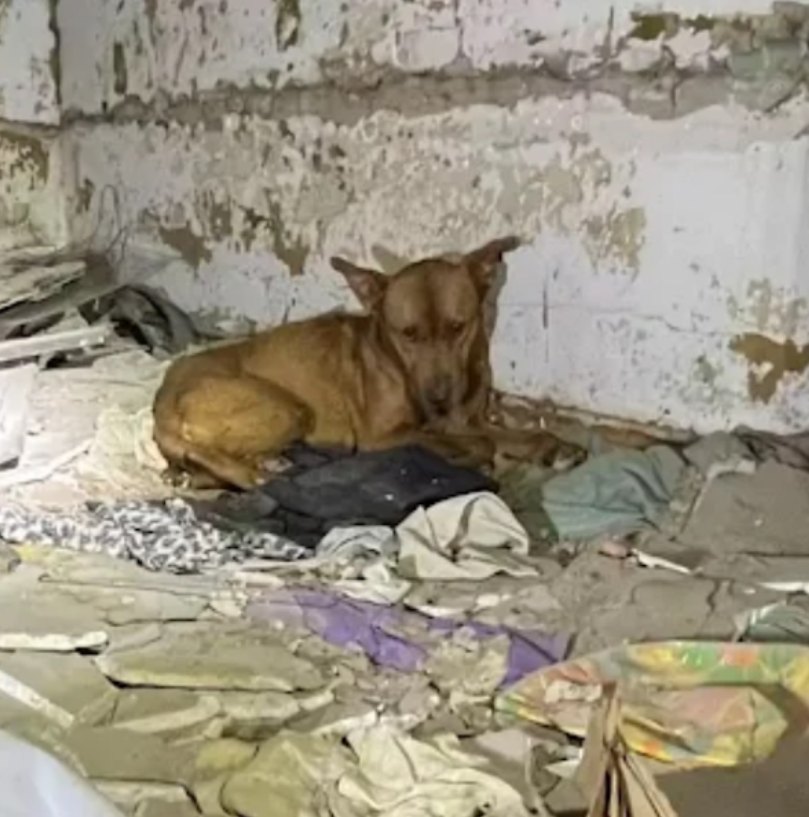
In a forgotten corner of St. Louis, Missouri, where an abandoned building stood silent and decaying, a small story of fear slowly transformed into one of relief, safety, and quiet hope. It began with concern—an ordinary report from a Good Samaritan who had noticed a distressed dog in the area. That report reached Stray Rescue of St. Louis (SRSL), an organization known for stepping into some of the most difficult and neglected spaces to find animals in need.

At the center of this effort was Donna Lochmann, the shelter’s chief life-saving officer, a role that often places her at the front line of rescue missions where uncertainty is the only guarantee. With years of experience in tracking and saving abandoned animals, she set out with her team, expecting another challenging case—but not yet knowing how hidden this one would be.
On her first attempt, the search led nowhere. Floor after floor of the abandoned building was carefully checked, each room echoing with emptiness. Dust, debris, and silence filled every corner. There was no sign of the dog—no movement, no sound, nothing to suggest life was still present inside. It would have been easy to conclude that the report was mistaken or that the animal had already moved on. But rescue work rarely allows for simple conclusions.
Lochmann later reflected on that first attempt, describing how thorough the search had been and how frustrating the lack of results felt. Still, something about the situation lingered. There were continued reports of barking from within the building, faint but persistent, and as temperatures dropped, the urgency increased. Cold weather is especially dangerous for stray and abandoned animals, and time was becoming a critical factor.
So she returned.
On the second visit, the situation shifted in a small but meaningful way. As Lochmann approached the rear of the building, she spotted a dog lying in the grass. The animal was still, watchful, and clearly aware of human presence. The moment contact seemed possible, the dog reacted instinctively—darting away and disappearing back into the broken structure, as if the building itself was both shelter and prison.

That brief glimpse confirmed what the earlier silence had hidden: the dog was indeed inside, frightened enough to avoid detection, yet unwilling or unable to leave the only place she recognized as cover.
Understanding that immediate pursuit would likely push the dog deeper into fear, Lochmann chose not to force the situation. Instead, she and her team withdrew temporarily, planning a more careful approach for the following day. Rescue, especially in cases involving fearful or traumatized animals, often depends less on speed and more on patience.
When the team returned, they came prepared to navigate the building more systematically. The search was slow and deliberate, moving through unstable corridors and debris-filled rooms, listening carefully for any sign of life. Then, finally, they heard it—a bark echoing through the hollow structure. It was faint but real, cutting through the silence like a signal finally answered.
Following the sound led them deeper into the ruins, where they eventually found her.
The dog was lying among rubble, trembling so intensely that her body seemed unable to fully settle. Every movement of her legs reflected not just cold, but overwhelming fear. It became clear that her shaking was driven more by anxiety than by temperature alone. She was trapped in a state of constant alertness, unsure whether the approaching humans meant safety or danger.
Rather than attempting a direct leash capture, which could have intensified her fear or caused her to flee further, the rescuers chose a gentler method. They slowly guided her into a plastic crate, allowing her to move at her own pace without force. This approach—calm, controlled, and non-threatening—helped reduce the immediate stress of the situation.
Once inside the crate, something shifted. The dog, later named Habanero, began to settle. The shaking eased slightly, and her breathing became less erratic. For the first time during the rescue, containment did not feel like threat—it felt like protection. Carefully, the team transported her out of the building and into safety, loading her into Lochmann’s Jeep and heading back to the shelter.

At Stray Rescue of St. Louis, Habanero received a full medical evaluation. Physically, she was in relatively good condition considering her circumstances. There were no severe injuries or life-threatening illnesses detected. However, her emotional state told a different story. She was anxious, cautious, and deeply unsettled, reacting strongly to unfamiliar sounds and movement.
Fear, in rescued animals, often lingers longer than physical wounds. While the body can heal with treatment and time, trust takes longer to rebuild. In the early days at the shelter, Habanero remained guarded. Sudden noises or changes in environment could trigger her anxiety, and she often retreated into herself.
But the environment around her was consistent, patient, and calm. The staff did not rush her progress. Instead, they allowed her to observe, adjust, and slowly participate in daily routines on her own terms. Gradually, small changes began to appear. Her posture relaxed. The trembling became less frequent. Her responses to human presence softened.
Donna Lochmann and the team also spent time with her outside of medical care—walking with her, sitting nearby, and simply existing in the same space without expectation. These moments, though simple, are often the foundation of rehabilitation for fearful dogs. They communicate safety without pressure.
Over time, Habanero began to bond with the people caring for her. The fear that once defined her behavior started to give way to curiosity and trust. She began to walk more confidently, explore her surroundings, and engage with the world beyond the shelter walls.

This transformation, however gradual, marked an important milestone. It suggested that she was ready for the next stage of recovery: transitioning from shelter life into a foster home, where she could continue building confidence in a quieter, more personal environment.
Lochmann acknowledged that adjustment would still be necessary. Dogs coming from traumatic or uncertain backgrounds often carry remnants of fear into new settings. But she also expressed confidence in Habanero’s ability to adapt, noting the progress she had already made and the resilience she had shown.
What makes Habanero’s story meaningful is not only the rescue itself, but the process that followed. It is a reminder that saving an animal is not a single moment, but a series of choices—choosing to search again when the first attempt fails, choosing patience over force, and choosing consistency over urgency when healing begins.

Her journey also reflects a broader truth about animal rescue work: many of the animals found in abandoned spaces are not just physically displaced, but emotionally affected. Fear can be as limiting as injury. Yet with time, care, and stability, even deeply frightened animals can rediscover trust.
Today, Habanero’s story stands as a quiet example of what persistence and compassion can achieve. From a trembling presence hidden in a collapsing building to a dog learning to walk without fear, her progress represents more than survival—it represents recovery.

And while her journey is still continuing, each step forward brings her closer to something she was once denied: a life where safety is not temporary, but permanent.
Lawson’s Miraculous Journey: From Struggling Stray to Wheelchair Warrior in Istanbul
Lawson’s story begins on the outskirts of Istanbul, where life on the streets can be especially harsh for stray animals, particularly those who are injured and unable to care for themselves. For a young one-year-old dog like Lawson, the world should have been full of curiosity, play, and discovery. Instead, his early life was defined by survival.

A car accident changed everything. The impact left Lawson unable to use his back legs, forcing him into a daily struggle most animals would not be able to endure. With limited mobility, he was no longer able to move freely in search of food or safety. Instead, he had to drag his paralyzed body across uneven streets, a painful and exhausting effort that only worsened his injuries over time. Every movement became a challenge, and every day was a test of endurance.
Living as a stray in such a condition is especially difficult in environments where injured animals are often overlooked. In many places, including parts of Turkey, street dogs face constant uncertainty, and those with disabilities are even more vulnerable. Without access to consistent medical care or protection, their chances of survival are significantly reduced. Lawson was caught in exactly this kind of reality—young, injured, and largely invisible to the world around him.
But his situation was not without hope.
The organization He’Art of Rescue eventually encountered Lawson during this vulnerable period. Their work focuses specifically on helping injured and neglected animals, especially those who would otherwise be left behind. When they found him, they immediately recognized both the severity of his condition and something equally important—his resilience.

Despite the trauma his body had endured, Lawson was still fighting to survive. His physical condition bore clear signs of hardship: worn skin, visible injuries, and exhaustion from repeated effort to move. Yet even in this state, there was something striking about him. He was still present, still responsive, still holding on. For rescuers, these small signs often become the reason to act quickly.
They brought him into care, marking the beginning of a completely different chapter in his life.
It is important to understand that Lawson’s spinal injuries could not be reversed. The damage caused by the accident was permanent, and no medical treatment could restore full function to his hind legs. However, this did not mean that improvement was impossible. In modern animal rehabilitation, mobility aids such as wheelchairs can dramatically change the lives of paralyzed animals, allowing them to regain independence and movement.
For Lawson, this became the turning point.

After receiving a specially fitted wheelchair, he was introduced to a new way of moving through the world. At first, like many animals adjusting to mobility devices, he needed time to understand how it worked. The sensation of support where there had once been none was unfamiliar. But dogs are often remarkably adaptable, and Lawson was no exception.
Within just a few days, he began to take his first tentative steps using his wheelchair. What had once been a body dragging helplessly across the ground was now a supported frame capable of movement. Each small push forward represented not just physical progress, but emotional recovery as well.
Soon after, Lawson’s confidence grew. He began to experiment with speed and direction, gradually learning how to maneuver his wheels more effectively. What started as cautious movement quickly transformed into moments of joy. He would zoom forward, explore his surroundings, and engage with the environment in ways that had once seemed impossible for him.

This change is often one of the most powerful aspects of rescue rehabilitation: when an animal realizes that limitation does not mean the end of experience. For Lawson, the wheelchair was not just a medical device—it was a restoration of possibility.
As he settled into life under the care of He’Art of Rescue, his personality began to shine through more clearly. The stress and fear that often accompany street survival started to fade, replaced by curiosity and a visible sense of comfort. His expression, described by rescuers as cheerful, reflected not only improved physical comfort but also emotional healing.

This transformation did not happen in isolation. It was the result of consistent care, patience, and a structured environment designed to support animals with special needs. Rehabilitation for paralyzed animals often requires ongoing adjustments—both in equipment and in daily routines—but the effort pays off when the animal begins to thrive again.
Lawson’s journey also highlights an important truth about disability in animals: mobility impairment does not eliminate the capacity for happiness, play, or connection. With the right support, animals like Lawson can live full and meaningful lives, even if their physical abilities are different from before.

Over time, he began to interact more confidently with his surroundings and the people caring for him. Playtime became part of his routine. Movement became something he could enjoy rather than struggle against. Each day added another layer to his recovery—not by reversing his injury, but by helping him adapt and rediscover joy within his new reality.

His progress serves as a reminder of what compassionate intervention can achieve. Without rescue, Lawson’s condition would likely have continued to deteriorate on the streets. With rescue, however, his life was redirected toward stability, care, and dignity.

It is also worth noting that stories like Lawson’s reflect a broader need for awareness about injured street animals. Many animals with treatable or manageable conditions remain unseen, simply because they cannot reach help on their own. Organizations like He’Art of Rescue play a crucial role in bridging that gap, but they also rely on public awareness and support to continue their work.

Lawson’s journey—from a paralyzed stray struggling across city streets to a wheelchair-enabled dog enjoying movement and companionship—is not just a rescue story. It is a demonstration of adaptation, persistence, and the impact of compassionate action.

Today, he continues to explore his world on wheels, no longer defined by the accident that changed his life, but by the care that gave him a second chance.
From Shunned to Shining: The Incredible Journey of a Once-Abandoned Puppy to Beloved Companion
Once, a tiny puppy was abandoned abruptly—not because of anything she had done, but simply because someone judged her as not “beautiful enough” to keep. Left alone in the world, she had no guidance, no protection, and no reassurance. The rejection was abrupt, harsh, and unfathomable for such a small, innocent creature.