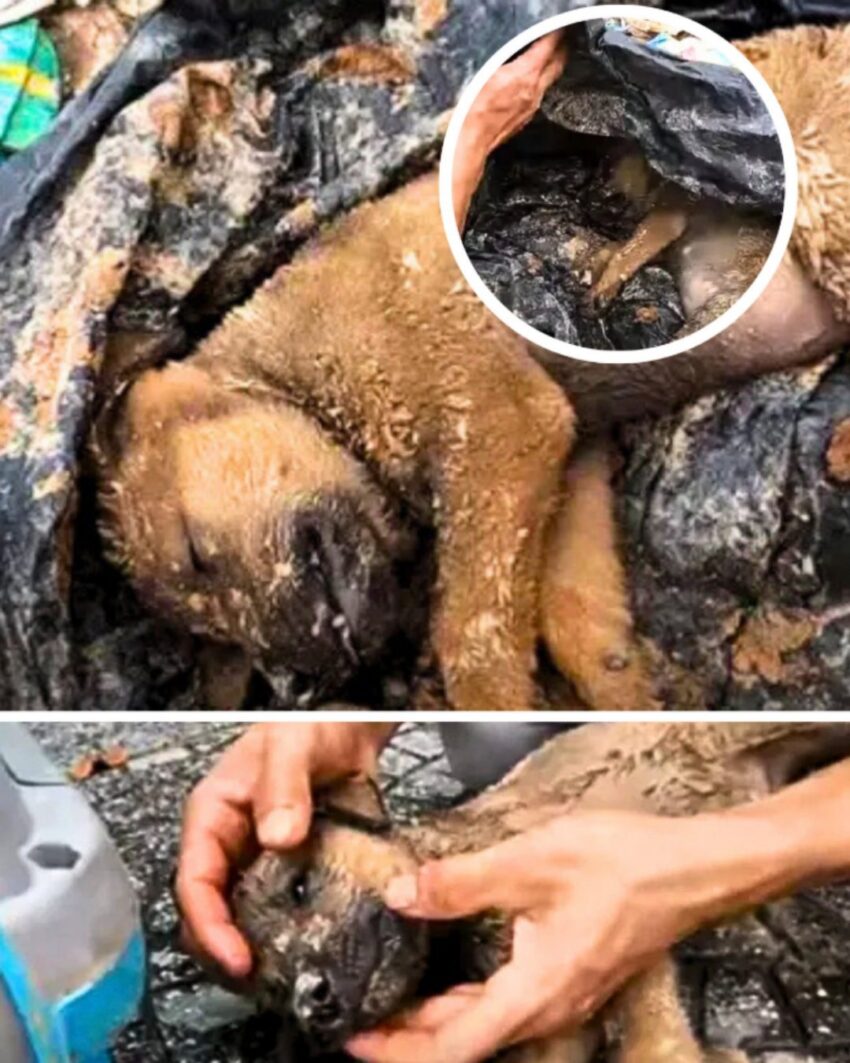
The discovery of an abandoned puppy rarely happens in a dramatic way. There are no sirens, no crowds, no warning. It happens quietly, often in places people pass every day without noticing. A patch of weeds beside a road. A cardboard box behind a store. A trembling shape near a parking lot with nowhere to go. And yet, for the person who stops, that moment becomes unforgettable.
The puppy is usually small, filthy, and exhausted. His fur is stiff with dirt and rain, his body painfully thin, his ribs pressing against skin that has known far too much hunger. He shakes not only from cold, but from fear. When someone approaches, he does not know whether the hand reaching toward him will bring comfort or harm. His eyes tell the story before he ever makes a sound. They carry confusion, distrust, and a fragile hope that has not quite disappeared.
For the person who finds him, something shifts instantly. There is a pull that cannot be ignored. Kneeling down, speaking softly, offering food or simply patience, the rescuer interrupts what could have been a tragic ending. In that moment, a choice is made. The puppy is no longer invisible.

When the puppy is finally lifted into safe arms, the reality of what he has endured becomes impossible to ignore. He was discarded. Left behind as though his life held no value. And yet he survived. He kept breathing. He kept hoping. That resilience awakens something powerful in the person who saved him. A silent promise forms, clear and unbreakable. You are not alone anymore.
The days that follow are rarely easy. Trauma lingers even after danger has passed. The puppy flinches at sudden movements. He hides in corners. He keeps his tail tucked low, unsure whether safety will last. Fear does not disappear overnight. It loosens slowly, only when kindness proves consistent.
Feeding becomes the first bridge of trust. At first, the puppy eats as though the bowl might vanish at any moment. He glances up nervously, unsure whether he is allowed to finish. But the bowl stays. It is refilled. The rescuer returns again and again. With every meal, the puppy learns something new. Food does not disappear. Care is not temporary.
Baths come next, each one a quiet test of patience and endurance. Soap and water are strange and threatening at first, yet the gentle hands that scrub and rinse never hurt him. Slowly, fur begins to glimmer under the light, revealing the natural color beneath the grime. The puppy begins to lift his head a little higher each day. He begins to see that the world is not only harsh; it can also be tender.
Walks in the nearby park are the first adventures beyond the small, safe room. Each new sound, scent, and movement challenges him, yet with the rescuer by his side, courage grows. He learns to trust his legs to carry him safely, to follow the reassuring voice calling his name, to wag a tail in delight without fear.
May you like
Sleep is a ritual of healing. In the beginning, he curls in tight circles, ears twitching at the slightest noise. But over time, he stretches and relaxes, finding warmth in the shared space of the bed. He dreams not of past hardship, but of running across sunlit fields, of soft hands rubbing his ears, of laughter and gentle whispers that tell him he is loved.
Yet the transformation is not just in the puppy. The rescuer, too, changes in subtle, profound ways. A heart once preoccupied with everyday concerns now beats with extra awareness of small miracles. The simple act of offering safety and love to a creature in need becomes a mirror reflecting patience, resilience, and empathy back to the giver. The puppy’s recovery is a daily lesson in hope: that life can mend, that trust can be rebuilt, and that kindness has a ripple effect far greater than imagined.

Months pass, and the puppy—now named Milo—blossoms. His fur is soft and full, his eyes bright and mischievous, his tail a banner of newfound confidence. He runs in wide arcs across the yard, chasing leaves and shadows, barking at birds, and rolling in the grass with pure joy. Every leap is a celebration of survival, every playful growl a testament to resilience.
Milo forms bonds not only with the rescuer but with everyone he meets. Strangers at the park stop to marvel at his energy, children giggle at his antics, neighbors pause to watch him curl up at the doorstep. He spreads joy effortlessly, reminding all who encounter him that even the smallest life can carry immense light.
The rescuer often watches Milo in quiet moments and feels the full weight of the journey they shared. The memory of that first day—the trembling, dirty puppy who barely dared to look up—feels almost unreal. And yet, it is precisely that memory that gives every victory meaning. It is proof that love and patience, when unwavering, can turn despair into delight, fear into courage, and abandonment into belonging.
Then one winter evening, as snow drifts softly onto the quiet street, the rescuer notices Milo gazing out the window, ears perked and tail wagging. A single car passes, a child laughs in the distance, and Milo bounces back to the warmth of the living room, chest heaving with happiness. In that moment, the rescuer understands something deeply human and universal: saving a life is never a one-sided act. In giving safety and love, one receives the gift of witnessing the miracle of recovery, of seeing joy reborn, of knowing the profound difference a single act of compassion can make.
Milo curls up next to the rescuer that night, and for the first time, they do not simply occupy the same space—they share a bond forged in adversity and nurtured by gentle care. Each heartbeat, each breath, speaks silently but loudly: we made it through. And though the world remains unpredictable, both know, without doubt, that together, they can face it all.

In the end, Milo is more than a puppy. He is a living testament to hope, resilience, and the transformative power of love. His journey from abandoned, frightened creature to a vibrant, joyful companion serves as a reminder that every life, no matter how small or seemingly insignificant, holds the capacity to inspire and touch hearts. Those who stop, who choose to care, create ripples that extend far beyond themselves. A single act of kindness can set a lifetime of happiness in motion, proving again and again that the world is made brighter, heart by heart, life by life.
And sometimes, all it takes to change a life is a quiet moment, a hand extended, and the courage to see someone—or some small being—who has been invisible for too long. Milo’s eyes, once full of uncertainty, now shine with trust, love, and the unspoken promise that he will never be alone again. And in those eyes, the rescuer finds a reflection of something equally profound: the undeniable truth that saving one life can save two, and that in every act of compassion, the world becomes a little more human, a little more hopeful, and a little more whole.
Unbroken Bonds: The Man Who Carried Love Beyond Life1081

There are moments in life that define us—not through achievement or fame, but through the quiet, enduring power of love. This is the story of a man and his dog, two souls who had weathered years of hardship together, finding companionship and strength in a world that often offered neither.
For years, the dog had been his constant companion. Through cold nights and empty days, they survived together on the margins of society, finding solace in each other’s presence. Where others might have felt loneliness or despair, the man had a friend who never judged, who never left, who greeted him each morning with unconditional warmth. Their bond was more than companionship—it was lifeline and sanctuary, a source of courage in the face of relentless struggle.
But one morning, the world shifted. The man woke to silence. The familiar weight of his friend at his side was gone. The dog, faithful and unflinching through every hardship, had passed. For anyone else, it might have been just a death. For him, it was the end of an era, a quiet devastation. The loss was not abstract; it was tactile. The dog had been more than a pet—he had been family, a heartbeat of comfort and joy in a life that had known little of either.
Grief settled on the man like a physical weight. He could have let it crush him, could have abandoned the remains to the indifference of the street. But instead, he acted. Using broken boards, remnants of a life built from scraps, he constructed a small stretcher. With trembling hands, he wrapped his dog gently, tied the bundle securely to his back, and began to walk. Step by careful step, he moved forward—not out of duty, not out of expectation, but out of love. Each movement was an expression of devotion, a testament that the loyalty they had shared did not end at death.
Passersby stopped. Some stared in confusion or disbelief. A man carrying a dead dog through the streets is a sight no one forgets. Whispers followed him. Some saw tragedy. Others saw madness. But those who understood the depths of love and loyalty recognized something far greater—a heart refusing to let go, a bond unbroken even when life had ended.
For hours, perhaps days, he walked. There were no shortcuts, no convenience, only the rhythm of his steps and the weight of his companion. Each movement became an act of remembrance, a declaration that the dog’s life, and their shared journey, mattered. In a world that often overlooks the vulnerable, this simple act became profound. He had nothing material to offer, yet he offered dignity, reverence, and honor—the highest tribute possible.
His journey soon captured attention. Local residents and volunteers began to understand that this was not a story of sorrow alone, but of resilience, of devotion, of the enduring power of companionship. People began leaving food and water along his path, small gestures of recognition for an act that transcended explanation. They understood that love, even in its most raw and unglamorous form, is a force powerful enough to inspire others, to remind humanity of its capacity for loyalty and kindness.
Each step the man took was also a story of survival. Homelessness, isolation, and poverty had marked his life, yet even in this precarious existence, he demonstrated the strength of character that only love can forge. The dog had been his anchor, and carrying him forward was not just an act of grief but of testament—a refusal to let their shared years be forgotten, a promise that even in death, the bond mattered.
Volunteers from animal shelters and community organizations eventually intervened, offering support. They assisted in ensuring the dog could receive proper care, even posthumously, and helped the man navigate his journey forward. Yet the symbolism of the act remained in the hearts of all who witnessed it: a reminder that love cannot be measured in convenience, comfort, or societal expectation. True loyalty often demands sacrifice, courage, and action beyond what seems reasonable.
The story also illuminated the profound connection between humans and animals. The dog, though unable to speak, had taught lessons in trust, companionship, and unyielding devotion. His presence had shaped the man’s life, offering not only emotional support but also a model of unconditional loyalty. When the dog passed, that model did not vanish; it became a guiding principle for action, a beacon of what it means to honor a life that mattered.
As news of the man and his dog spread, it resonated deeply. Social workers, animal lovers, and everyday citizens shared the story, not as a spectacle, but as a powerful example of the capacity for love to transcend circumstance. It became a touching story, a heartwarming story, and an inspiring story all at once—a testament that even the most marginalized among us are capable of profound acts of humanity.
For the man, the journey did not end with the burial of his companion. The lessons carried forward transformed him in subtle, enduring ways. Community members reported seeing him engage with other animals, offering kindness and protection to those in need. His empathy, forged through years of companionship and loss, radiated outward, turning grief into purpose. The bond he had shared with his dog became a catalyst for a life of quiet service and devotion, a reminder that the heart’s capacity for love is infinite.
The story also speaks to a universal truth: that acts of love and loyalty are not always visible or celebrated, yet they carry immense significance. In a world preoccupied with status, achievement, and recognition, the man’s quiet, unwavering devotion to his dog reminds us that the most meaningful acts are often simple, personal, and profoundly human. They are found not in grand gestures but in everyday expressions of care, courage, and constancy.
In reflection, the journey of the man and his dog is a moving narrative about the power of connection. It is a story that touches hearts because it embodies values that resonate universally: loyalty, love, courage, and empathy. It reminds us that every life—whether human or animal—holds significance, and that honoring that life, even in death, is an act of profound meaning.
Though the dog no longer walks beside him, the man continues to carry the lessons learned through their shared years. The weight on his back may have shifted from physical to symbolic, yet every step he takes reflects the enduring bond that cannot be broken by time or mortality. People who encounter him now recognize not just a man who carries a memory, but a living testament to the power of love that transcends circumstance.
Ultimately, the story serves as an inspiring reminder that loyalty and love are not bound by convenience, longevity, or recognition. They are measured in the courage to act, the willingness to sacrifice, and the devotion to honor those who matter most. The man and his dog teach that the deepest connections do not end with death—they endure, echoing through the actions and hearts of those left behind.
And as the man continues forward, each day carrying both memory and meaning, the world watches quietly, reminded that love has no limits, loyalty knows no bounds, and the next chapter in this extraordinary story might reveal a moment even more profound, where the lessons of devotion and heart will continue to…Continue reading